Introductory Reading
Complied by Rev. Protopresbyter Peter Delvizis
Apolytikion of John the Theologian
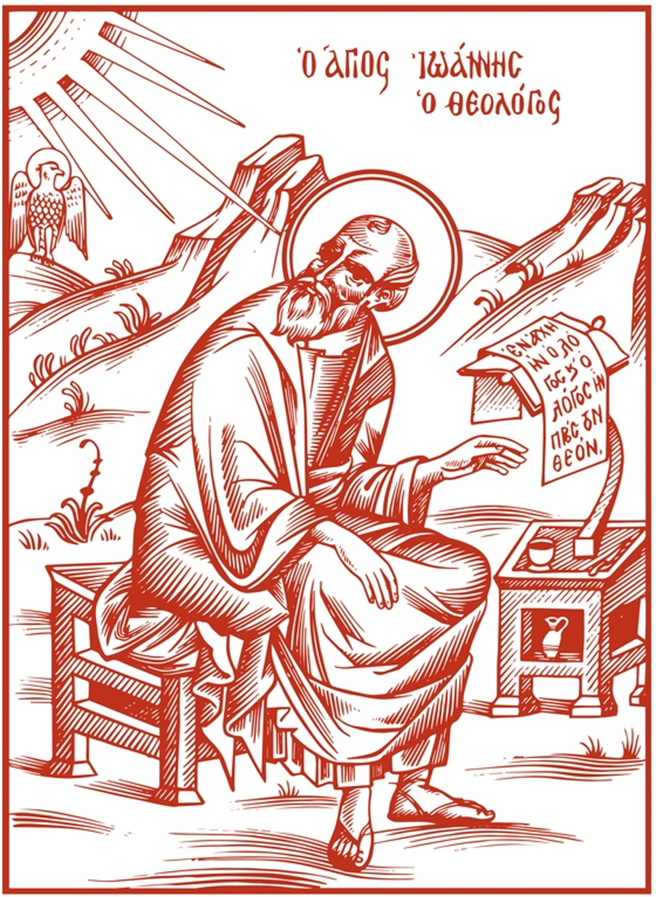
“Beloved Apostle of Christ our God, hasten to deliver a people without defense. He who permitted you to recline upon His bosom, accepts you on bended knee before Him. Beseech Him, O Theologian, to dispel the persistent cloud of nations, asking for us peace and great mercy.”
Introduction
Authorship – St. John the Apostle, Evangelist, and Theologian. This Gospel is a theological treasure because of the immensity of it message. It differs radically from the other Gospel accounts in that it focuses more on the divinity of Christ; the eternal Son of God taking on human flesh. It speaks of mystical and theological perspectives not as prevalent in the other accounts. God is mysterious yet working tangibly in the world. There is a clear Paschal theme throughout. St. John also teaches the perfection of God’s love within us. Written in Second Century, he must have been about 100 years old and banished to Patmos when it was complete. Because it is the last of the four Gospels, it reflects a period of unprecedented polemic and antagonism between the emerging Church and the religious establishment of the Jewish people. The Synoptic Gospels are concerned with Jesus’ public ministry of preaching the Gospel. John presupposes knowledge of the Synoptic Gospels and because of this he offers a deeper dimension based upon Christ’s divinity.
The Synoptic Gospels focus on the coming of the eternal Kingdom. While St. John emphasizes the a personal Christ who is the eternal King. They look at the essential value of the evangelical message in its entirety, while John on the messenger who is from heaven. Because of John’s approach, Parables decrease while theological discourses are common.
The purpose of the Gospel is:
a) vs. 20:31 “These signs are written that you may believe that Jesus is the Christ, the Son of God, and that believing you may have life in His name.” St. John seeks to prove that Christ is God incarnate, and that only through faith in Him can we have life.
b) To fight philosophical heresies in found in the church of Ephesus contradicting the principal message of Christianity: namely, that the Lord Jesus Christ accepted a human nature while remaining the eternal Son of God.
St. John introduces us to places and people not appearing in the other Gospels. Nicodemus, the Samaritan woman, and Lazarus emerge as important figures who allow for the development of highly established theological perspectives. These prominent figures do not appear in the Synoptic Gospels. Thomas and Philip, who are only mentioned by name in the others, become more animated by asking questions and offering comments. All four Gospels record the narrative of the death, crucifixion, and Resurrection of Jesus.
The purpose of miracles in John is to bring light to Christ’s divine origin and mission. These miracles are called “signs” and often lead to extensive discussions and debates about the identity and significance of Jesus.
The man – St. John
John is the son of Zebedee, and his brother James were the grandsons of Joseph, the betrothed of the Virgin Mary. John’s mother, Salome, was one of the myrrh-bearing women. She was also Jesus’ stepsister and a very close confidante of the Virgin Mary. Thus, it was quite natural for the Lord to entrust the care of His mother to John at the cross (John 19:25-27[1]) since Mary and Salome were such close friends.
John was an extremely mild, calm, and peaceful man who emphasized the need of love between brethren. This love goes beyond mere brotherhood to participation in divine life. Despite his mildness, he was thunderous in his proclamation of the Gospel, a true zealot for Christ.
Throughout John’s Gospel, he refers to himself as “the disciple whom Jesus loved” (John 13:23, 19:26, 20:2, 21:7, 20)
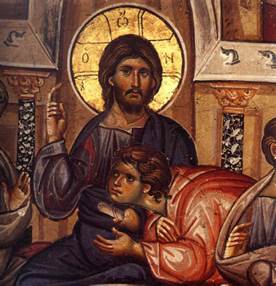
John was probably the youngest of the twelve disciples. Being Jesus’ relative (either step-nephew or second cousin, once removed), he was treated very tenderly by the Lord (John 13:23-25)[2].
He had keen perception of the mysteries surrounding Christ and was the first to recognize the risen Christ at the Sea of Galilee while they were fishing.
Because of his perception he was blessed to have the Lord show him many things about the mystical nature of heaven. Like Isaiah before him, John gazed into heaven. Piercing the inner veil of heaven, he was able to write about celestial activities and future events regarding the Parousia of Christ. Because of this extraordinary blessing he was directed to write the Book of Revelation.
John’s care of the Virgin Mary after Pentecost
At the foot of the Cross, Jesus assigned the care of His mother to the Apostle John. This was necessary in 1st Century Jewish culture. The oldest son in the family had the “birthright” and was expected to care for his mother for the rest of her life in the event of his father’s death. He was given an extra share of the birthright to do this. Out of this extra share, he was also expected to provide for any unmarried sisters, including their dowry upon marriage
(Deuteronomy 21:15-17).
The Virgin Mary lived in John’s house along with John’s mother, Salome, until her death. This implies that Salome’s husband, Zebedee, died shortly after Pentecost. John was very prominent in the early Church. This is noticeable when St. Paul came to Jerusalem in c. 48 AD for the Council in Jerusalem regarding the issue of circumcision of the Gentiles (Acts 15). At that time, Paul perceived that James, Peter and John were the pillars of the Jerusalem Church (Galatians 2:9)[3]. This James was James the Lord’s brother (Galatians 1:19), and not John’s brother James. John’s brother had already been martyred in 44 AD (Acts 12:1-3).
When persecution began for the newly founded Church during the time of Herod, John and the Virgin Mary left Jerusalem. Since John’s lot in the evangelization of the world was Asia Minor, they sailed for Ephesus. There they stayed until the death of Herod (Acts 12:20-23). To put this in context, the Apostle Andrew had already been to Ephesus briefly, the Apostle Paul would not arrive until 52 AD, at the end of his Second Missionary Journey. Since Herod died not too long after he killed James, John and the Virgin Mary most likely stayed in Ephesus less than two years. As was her custom, the Virgin Mary spent most of the day in prayer, fasting, and meditating on the Scriptures. John and Mary returned to Jerusalem following the death of Herod, and remained there until the early 50’s. About that time, Mary heard that Lazarus, the brother of Mary and Martha desired to see her very much. Lazarus had been ordained Bishop of Cyprus by the Apostle Barnabas but did not dare enter Jerusalem for fear of the Jews. It had been over 20 years since the Jewish leaders had tried to kill him; but they still sought to do so (John 12:9-11).
To solve this dilemma, Mary wrote to Bishop Lazarus asking him to send a ship for her so that she might visit him on Cyprus. This he did and the Apostle John with the Virgin Mary and some others set sail for Cyprus. Out at sea, however, they encountered a violent storm that took them far off course and up to the northern part of the Aegean Sea near Macedonia.
There, they pulled into the port of Clemes on Athos at the tip of the 50-mile long peninsula. At this location today, there are a number of famous monasteries that trace their origin to the visit of John and the Virgin Mary in the early 50’s, and most of the information we have concerning the Virgin Mary’s voyage comes from these monasteries.
At that time, the population of Athos consisted of young virgins dedicated to the goddess Artemis (Diana) who were expected to become priestesses to serve in the Greek temples. Also on Athos was a large gold and ivory statue of Zeus (Jupiter) on top of the 6,600-foot peak of Mt. Athos. This statue was mentioned in ancient history accounts of Plutarch and Anaximander as having large gems for eyes; it was used for navigation purposes by seamen. Also present on the peninsula was a huge temple of Apollo where fortune telling, divining and witchcraft took place.
When John and Mary arrived at the port of Clemes, the huge statue of Zeus fell and shattered into pieces with thunderous noise. At the same time, the ground shook the idols and pagan statues in the temple and in all the shrines fell prostrate and broke in pieces. During the chaos of this collapse, a voice was heard saying, “Men of Apollo, all of you, go to Clemes Harbor and welcome Mary, the mother of the Great God Jesus”. Thus, the demons inhabiting the idols were forced against their will to proclaim the truth.
Seeing the destruction around them, all the inhabitants of Athos hurried to Clemes Harbor to meet the Virgin Mary. They received her, the Apostle John and the others with great honor and brought them to a large meeting hall. There they asked her to explain who was the God that she bore and they inquired diligently into the mystery of the Incarnation.
They also wondered at how Mary, a Hebrew woman, could explain everything to them in Greek. This was due to the gift of languages that Mary received along with the 120 at Pentecost (Acts 1:14, 2:1-3). All this resulted in the entire group of the residents of Athos accepting the Christian Faith. They were all then catechized and baptized into the Faith. During their stay on Athos, Mary and the Apostle John performed many miracles among the new converts. Before leaving, they appointed a leader and teacher for the newly illumined residents of Athos from among their traveling party.
In addition, Mary prayed for the blessing of Athos, that the Lord would have mercy on it and keep it free from harm until the end of the world along with its inhabitants. Because of the event leading the Virgin Mary to Mt. Athos, this land dedicated to this day is dedicated to the Most Holy Virgin Theotokos.
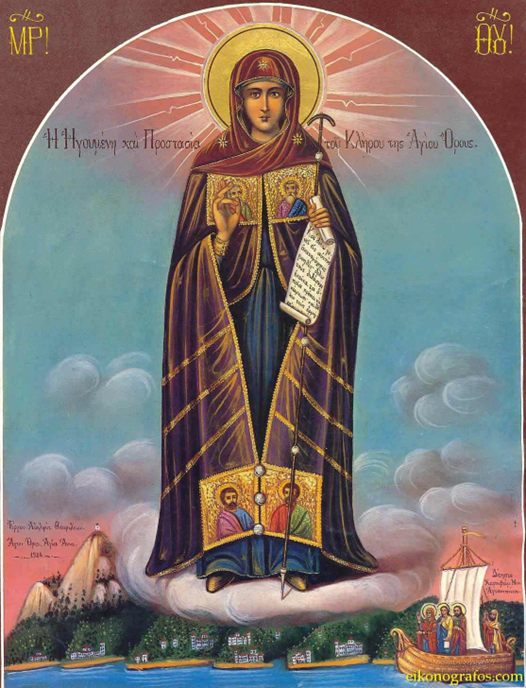
Having blessed Athos, Mary, John and the others set sail for Cyprus. Meanwhile, Lazarus had grown very concerned about Mary’s delay, assuming it was because of a storm, and not knowing that all was well. When the ship arrived, there was great rejoicing and thanksgiving. Mary presented Bishop Lazarus with an omophorion and spimanikia (part of a bishop’s vestments) that she had made. John and Mary shared the good news of all that happened on Athos.
After staying on Cyprus for a short time, Mary blessed the Christians there and returned to Jerusalem with John and the others. Shortly after Mary and John returned from Cyprus, Mary Magdalene also returned to Jerusalem from her evangelism in Rome and elsewhere. Since she had been very close to the Virgin Mary during Jesus’ three-year ministry, she stayed with the Apostle John for several years until the Virgin Mary’s death. At this time, the Virgin Mary was in her early 70’s and Mary Magdalene was in her late 60’s.
After the Panagia’s death and Assumption to heaven, John moved to Ephesus permanently. He was not pleased that the Lord had directed him there but this was to be the center of his missionary activity. After repenting of this sin, he began his life, and soul-saving activities. From Revelation 2 and 3, where John addresses seven Churches in Asia: Ephesus, Smyrna, Pergamon, Thyatira, Sardis, Philadelphia, and Laodicea, we see he had a hand in helping to cultivate these churches. All these Churches are within a 70-mile radius of what is today Western Turkey.
Because the Church started taking root and growing, the Christians were called into question and ostracized, persecutions fell upon them. John, being the leader, was arrested by Emperor Domitian, a great persecutor of the Christians in about 81 A.D. After many beatings, John was forced to drink a cup of strong poison and then was boiled in oil. Miraculously, neither had any effect upon him. Domitian thought John was immortal and had him exiled to the island of Patmos, a penal colony.
Three years after arriving on Patmos, John and his scribe Prochoros were in the marketplace near the temple of Apollo. Some of the priests of Apollo began to sneer at John and ridicule what he taught. The “son of thunder” prayed, and the temple of Apollo collapsed. The priests immediately grabbed John and inflicted many stripes on him; then they had him thrown into the deepest dungeon. When Myron and his family heard, they got John out – since they were an influential family.
Sometime later, a Jew named Philo met John in the marketplace and debated John on the Scriptures for two days. As John was debating, a young man brought a sick man for John to heal, which John did. Philo replied, “Teacher, what is love?” John responded, “God is love and he who has love has God.” Philo replied, “Therefore show the love of God and come home with me.” John did so and healed Philo’s wife of leprosy while he stayed there. Philo and his wife believed and were baptized.
In about 96 A.D., Emperor Domitian was assassinated, and his successor Nerva did not persecute the Christians. John was free to return to Ephesus.
By then, nearly all the inhabitants of Patmos had come to believe, and they wanted John to stay. When he told them that the Lord had instructed him to return to Ephesus, they asked him to draft a written document that they could use to remain steadfast in the faith. This John did later by dictating his Gospel to Prochoros who had Sosipater copy it on good quality parchment.
After bidding farewell (with many tears) to the residents of Patmos where John had spent 15 years, John and Prochorus sailed to Ephesus where they were received with great joy and stayed in the house of Domnus.
John spent the rest of his life in Ephesus in strict fasting and prayer, living as a Nazarite. Because of his age, he didn’t have the strength to preach anymore but taught only the bishops privately. St. Jerome stated that the faithful carried him to Church where he would say over and over “Little children, love one another.” When his disciples asked him why he just said this, he replied, “This is the Lord’s commandment; and if you keep it, it is enough.”
His Repose – September 26
John died in the third year of Trajan (about 106 AD) at the age of nearly 105. Most accounts state that John instructed seven of his disciples to go outside the city with him and dig his grave. John then climbed into his own grave and died there. The seven then buried him.
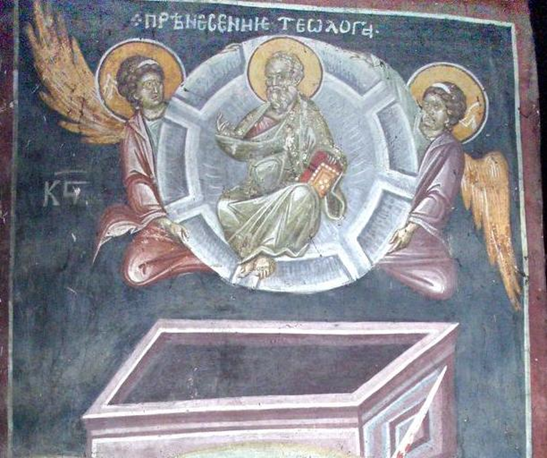
Later the faithful dug up the grave to give John a more prominent resting place, but the grave was empty. According to Tradition, St. John was raised from the dead and taken up into heaven like the Mother of God, in fulfilment of the Saviour’s enigmatic response to Peter’s question about John: “Lord, what about this man?” The Lord answered St. Peter by saying, “If it is My will that he remain until I come, what is that to you?” (John 21:22). The Divine John took his repose in the Lord and was translated to heaven on September 26.
Outline of the Gospel according to John
- 1:1-18 – The Prologue – An introduction and summary of the Incarnate Logos
- 1:19-12:50 – Part One: The Book of Signs
- 1:19-51 The initial days of revelation
- 2-4 From Cana to Cana
- Chapter 2 – Wedding at Cana, Cleansing of the Temple
- Chapter 3 – Nicodemus
- Chapter 4 – Samaritan Woman
- 5-10 Old Testament Feasts and the Trial of Jesus
- Chapter 5 – Healing on the Sabbath
- Chapter 6 – Passover – Bread of Life
- Chapter 7-8 – Feast of Tabernacles
- Chapter 9 – Man born blind
- Chapter 10 – Good Shepherd discourse
- The Raising of Lazarus
- The Hour has arrived
- 13:1-20:31 Part Two: The Book of Glory
- Chapter 13-17 – Farewell Discourses
- Chapter 18 – Arrest, Sanhedrin episode
- Chapter 19 – Trial before Pilate and Crucifixion
- Chapter 20 – Resurrection and events in Jerusalem
- 21:1-25 Part Three: The Second Ending
- Resurrection and events in Galilee
[1] “Now there stood by the Cross of Jesus His mother, and His mother’s sister, Mary the wife of Cleopas, and Mary Magdalene. When Jesus therefore saw His mother, and the disciple whom He loved standing by, He said to His mother, ‘Woman, behold your son!’ Then He said to the disciple, ‘Behold your mother!’ And from that hour that disciple took her to his own home.”
[2] “Now there was leaning on Jesus’ bosom one of His disciples, whom Jesus loved.”
[3] “James, Cephas, and John, who seemed to be pillars, perceived the grace that had been given to me, they gave me and Barnabas the right hand of fellowship, that we should go the Gentiles and they to the circumcised.”